

Nitrogen Fertilizer for Lawns: The Complete Guide
Learn about nitrogen fertilizer for lawns. Expert tips on fast vs slow release, rates, schedules, and avoiding common mistakes.
Introduction
A lawn that looks genuinely healthy — thick, deep green, resilient through summer heat — doesn’t happen by accident. Behind most great-looking turf is a solid nitrogen programme. Nitrogen is the engine of grass growth. It drives the lush green colour homeowners are after, fuels blade development, and keeps turf dense enough to crowd out weeds naturally.
But nitrogen is also the nutrient most homeowners get wrong. Too little and the lawn turns pale and thin. Too much and you risk burning the grass, accelerating disease, and polluting nearby waterways with excess nitrates. The timing, the product type, the rate — all of it matters more than most lawn care guides let on.
This guide breaks down everything you actually need to know: how nitrogen works in soil, which product to use for your grass type, how to read a fertiliser label, when to apply, and how to avoid the most common mistakes. Whether you’re starting fresh or trying to improve a lawn that’s never quite looked right, this is the foundation.
Why Nitrogen Is the Most Critical Lawn Nutrient
Grass needs 17 essential nutrients to grow, but nitrogen (N) is consumed in the largest quantities and has the most visible effect on appearance and density. It’s the first number in any fertiliser’s NPK ratio — a 30-0-4 fertiliser, for example, contains 30% nitrogen by weight.
Nitrogen directly fuels chlorophyll production. Chlorophyll is what makes grass green and what powers photosynthesis — the process by which the plant converts sunlight into the energy it uses to grow roots, shoots, and new blades. When nitrogen is abundant and properly timed, grass grows quickly, fills in bare spots, and develops a dense canopy that shades out weed seeds before they can germinate.
When nitrogen is deficient, the signs are hard to miss: pale yellow-green colour starting at the older, lower leaves; slow growth; thin turf that competes poorly against weeds; and reduced recovery after drought or foot traffic. Soils in most residential areas — especially those that have been sodded over compacted clay or built on disturbed subsoil — are naturally low in nitrogen and need regular replenishment.
The challenge is that nitrogen doesn’t stay put in soil the way phosphorus or potassium does. It leaches downward with rainfall, volatilises into the atmosphere, and gets consumed rapidly by active turf. That’s precisely why nitrogen fertilisation is a recurring, season-long commitment rather than a one-time fix.
Understanding the NPK Ratio on Fertilizer Labels
Every bag of lawn fertiliser displays three numbers separated by dashes. These are the percentages by weight of nitrogen (N), phosphorus (P₂O₅), and potassium (K₂O) — collectively called the NPK ratio.
A 50-pound bag of 32-0-8 fertiliser contains the following:
- 16 lbs of nitrogen (32% × 50)
- 0 lbs of phosphorus
- 4 lbs of potassium (8% × 50)
For lawn applications, nitrogen is almost always the focus. Phosphorus is rarely needed in established lawns — many soils already have surplus phosphorus, and applying more can cause runoff issues. Potassium supports stress tolerance and root development and is worth including in fall programs, but nitrogen drives the visible results homeowners care most about.
Reading the label also tells you whether the nitrogen is fast-release, slow-release, or a blend — information that’s just as important as the percentage itself.
Fast-Release vs. Slow-Release Nitrogen: What’s the Real Difference?
This is where a lot of lawn care decisions either succeed or fail. Fast-release and slow-release nitrogen behave completely differently in the soil, and using the wrong one at the wrong time creates problems.
Fast-Release Nitrogen
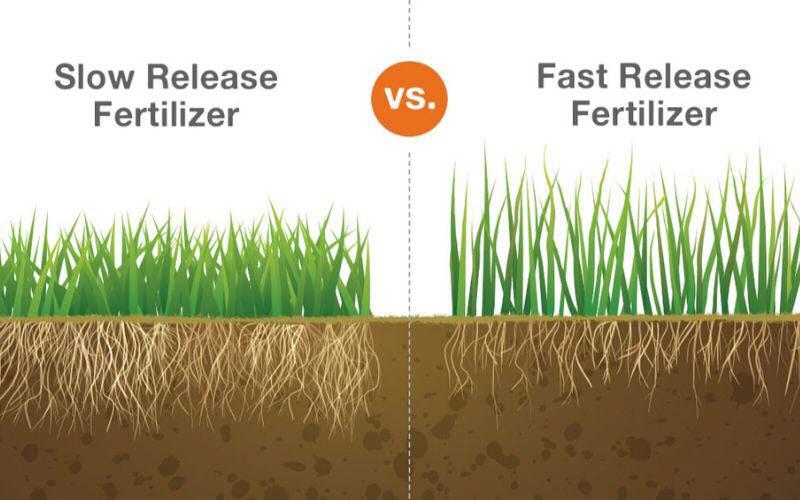
Fast-release sources – including urea, ammonium sulphate, and ammonium nitrate – dissolve quickly in soil moisture and become immediately available to grass roots. The results are dramatic: turf greens up within days and shoots into a visible growth flush.
The downside is just as dramatic. Fast-release nitrogen:
- Increases burn risk if applied at too high a rate or during heat
- Triggers a burst of growth followed by a crash as nitrogen is exhausted
- Leaches rapidly through sandy or compacted soils
- Requires more frequent applications to maintain color
Best use cases: Spring green-up, correcting nitrogen deficiency quickly, liquid lawn programs.
Slow-Release Nitrogen
Slow-release sources – sulphur-coated urea (SCU), polymer-coated urea (PCU), IBDU (isobutylidene diurea), and natural organics like feather meal or blood meal – break down gradually over weeks or months. They release nitrogen in sync with microbial activity and temperature, which naturally aligns with periods of active grass growth.
Slow-release nitrogen:
- Dramatically reduces burn risk
- Feeds more evenly over an extended period
- Reduces the total number of applications needed per season
- Is safer to apply during warmer conditions
- Costs more per bag but often delivers better value per pound of actual nitrogen
Best use cases: summer feeding when burn risk is high, slow-feed programmes, and premium turf management.
Most quality granular lawn fertilisers today are blends – containing a percentage of both fast- and slow-release nitrogen to deliver both an immediate green-up and sustained feeding. Look for products where 30–50% of the nitrogen is slow-release for most home lawn situations.
Nitrogen Rates: How Much Is Actually Enough?
The general rule for nitrogen application rates is no more than 1 pound of actual nitrogen per 1,000 square feet per application for cool-season grasses, and up to 1 pound per application for warm-season grasses like bermudagrass during peak growing season.
Here’s how to calculate the actual nitrogen in any fertiliser:
Pounds of N per 1,000 sq ft = (N ÷ 100) × pounds of product applied per 1,000 sq ft
So if you apply 3 pounds of a 32-0-8 fertiliser per 1,000 sq ft:
(32 ÷ 100) × 3 = 0.96 lbs of actual nitrogen – right at the safe limit.
Exceeding 1 pound of N per 1,000 sq ft in a single application with a fast-release product is when burn risk spikes — especially during summer or on stressed turf.
Annual nitrogen needs by grass type:
| Grass Type | Annual N Need (lbs/1,000 sq ft) | Peak Season |
|---|---|---|
| Kentucky Bluegrass | 3–5 | Fall |
| Tall Fescue | 2–4 | Fall/Spring |
| Perennial Ryegrass | 2–4 | Fall/Spring |
| Fine Fescue | 1–3 | Fall |
| Bermudagrass | 4–6 | Summer |
| Zoysiagrass | 2–4 | Summer |
| St Augustine grass | 2–5 | Summer |
| Centipedegrass | 1–2 | Late Spring |
Centipedegrass is notably sensitive — over-fertilising with nitrogen causes a condition called “centipede decline”, where the grass gradually deteriorates from excess stimulation.
Choosing the Right Nitrogen Fertilizer for Your Grass Type
Cool-Season Grasses (Kentucky Bluegrass, Tall Fescue, Ryegrass, Fine Fescue)
These grasses grow most actively in spring and fall when soil temperatures sit between 50°F and 65°F. They go semi-dormant in summer heat.
Recommended nitrogen programme:
- Early fall (late August–September): This is the most critical application. It replenishes nitrogen after summer stress and supports root development heading into winter. Use a blend with at least 30–40% slow-release nitrogen.
- Late fall (October–November): A “winterizer” application high in potassium and with some nitrogen (often called a 24-5-11 or similar ratio) strengthens the plant for winter and supports early spring green-up.
- Spring (March–April): Light application to support initial green-up. Avoid heavy nitrogen in spring — it pushes excessive shoot growth at the expense of root development.
- Summer: Minimal or no feeding unless using a very low rate of slow-release nitrogen. High nitrogen in summer on cool-season grass encourages disease and heat stress.
Warm-Season Grasses (Bermudagrass, Zoysia, St Augustine, Centipede)
These grasses grow actively from late spring through summer, going dormant when temperatures drop below 55°F.
Recommended nitrogen programme:
- Late spring (May–June): Begin feeding after the lawn has fully greened up from dormancy. Use a fast-release or blended product to drive active summer growth.
- Summer (June–August): Continue feeding every 4–6 weeks at moderate rates. Bermudagrass can handle 1 lb N per 1,000 sq ft per application during peak summer.
- Early fall (September): Final nitrogen application 6–8 weeks before expected first frost. Late nitrogen delays hardening off and increases winter kill risk.
- Winter: No nitrogen while dormant.
The Best Time to Apply Nitrogen Fertilizer to Your Lawn
Timing has as much impact as product selection. Even a great fertiliser applied at the wrong time can hurt more than help.
Key timing principles:
1. Match the application to active growth periods. Fertilising dormant or semi-dormant grass means the nitrogen sits in the soil, leaches away, or contributes to algae blooms in nearby water — without benefiting the turf.
2. Don’t fertilise drought-stressed grass. If your lawn is wilting or brown from heat and dry conditions, applying nitrogen stresses it further. Water first, wait for recovery, then feed.
3. Avoid fertilising right before heavy rain. A significant rainfall event after granular application can push nitrogen off the lawn and into storm drains. Check the forecast and aim for a light rain or irrigation 24–48 hours post-application to activate the granules without washing them away.
4. Don’t apply during the heat of the day. Apply granular fertiliser in the early morning or late afternoon when temperatures are cooler to reduce burn risk.
5. Follow the 4-6 week spacing rule. Fast-release nitrogen programmes should space applications at least 4–6 weeks apart. More frequent applications with fast-release products build up excess nitrogen faster than the grass can use it.
Organic Nitrogen Fertilisers: Are They Worth It?
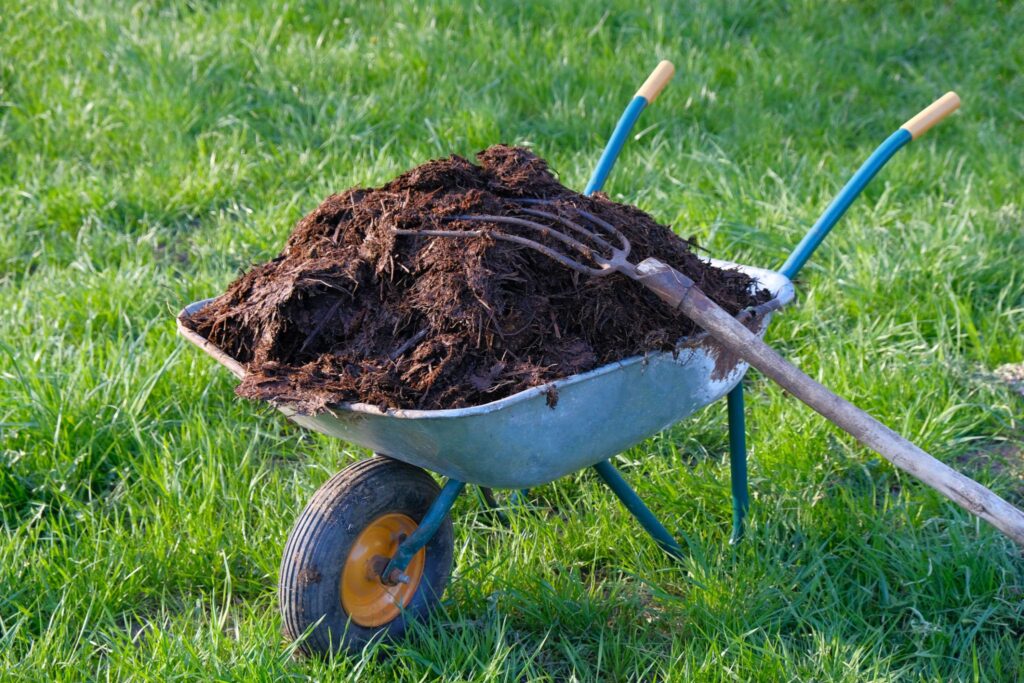
Organic nitrogen sources – feather meal, blood meal, bone meal, composted poultry litter, and soybean meal – are getting more attention as homeowners look to build long-term soil health rather than just feed grass blades.
The case for organic nitrogen:
- Feeds soil biology as it decomposes, improving soil structure over time
- Very low burn risk, even if over-applied
- Nutrients release in sync with soil temperature and microbial activity
- Reduces leaching risk significantly
The limitations:
- Lower nitrogen percentages per pound (blood meal at 12-0-0 vs. synthetic urea at 46-0-0)
- More bags required per 1,000 sq ft, which increases cost and labour.
- Takes longer to show visible results — often 2–3 weeks versus days for synthetic
- Odor can be significant, especially with blood meal or fish-based products
For most homeowners, a hybrid approach works well: organic-based fertilisers as the backbone of the programme (building soil health) with occasional synthetic nitrogen for rapid green-up when needed.
How to Apply Granular Nitrogen Fertilizer Correctly
The application method affects how evenly nitrogen gets distributed — and uneven distribution shows up as stripes or spots in your lawn within a week.
Equipment:
- Broadcast (rotary) spreader: The most common and most practical for most lawns. Throws granules in a wide arc, making it relatively fast. Best for large, open areas.
- Drop spreader: Drops granules directly below the spreader with no broadcast pattern. More precise but slower, and missing a pass creates unfertilised strips. Good for small, irregular spaces or near water features.
Application technique:
- Calibrate your spreader for the specific product. Bag labels list settings for common spreader brands.
- Apply in two perpendicular passes at half rate each to ensure even coverage.
- Overlap wheel tracks slightly to avoid gaps between passes.
- Avoid overlapping runs on already fertilised strips — this is how hot spots and burns occur.
- Clean out the spreader hopper after use and rinse with water to prevent corrosion.
After application:
- Irrigate lightly within 24 hours if no rain is expected — this activates granules and moves nitrogen into the root zone.
- For slow-release coated products, irrigation is still recommended but not as urgently required.
Liquid Nitrogen Fertilizers: A Different Approach
Liquid nitrogen fertilisers — typically sold as concentrated solutions that you dilute and apply through a hose-end sprayer or pump sprayer — have become popular for quick-response feeding and easier measurement on small lawns.
Common liquid nitrogen sources include:
- UAN (urea-ammonium nitrate solution): Used commercially but available in some retail products
- Chelated nitrogen solutions: Often combined with micronutrients
- Foliar urea blends: Applied directly to grass blades where some nitrogen is absorbed through the leaf tissue
Advantages of liquid nitrogen:
- More precise application rates on small areas
- Faster absorption — some foliar uptake bypasses soil altogether
- Easier to apply to sloped or oddly shaped areas
- Lower risk of uneven application compared to improperly calibrated granular spreaders
Limitations:
- More expensive per pound of actual nitrogen
- No slow-release options — all liquid N is fast-release
- Shorter residual feeding window
- Requires more frequent applications
For most homeowners managing a typical residential lawn, granular is the practical choice. Liquid nitrogen makes more sense for spot treatments, quick fixes, or small urban lawns where a spreader is impractical.
Signs Your Lawn Needs More Nitrogen (and Signs It Has Too Much)
Nitrogen deficiency symptoms:
- Uniform yellowing starting on older (lower) leaves and working upward
- Slow, minimal growth even during ideal weather
- Thin, sparse turf with visible soil through the canopy
- Poor recovery after traffic or drought
- Pale green rather than deep, saturated green color
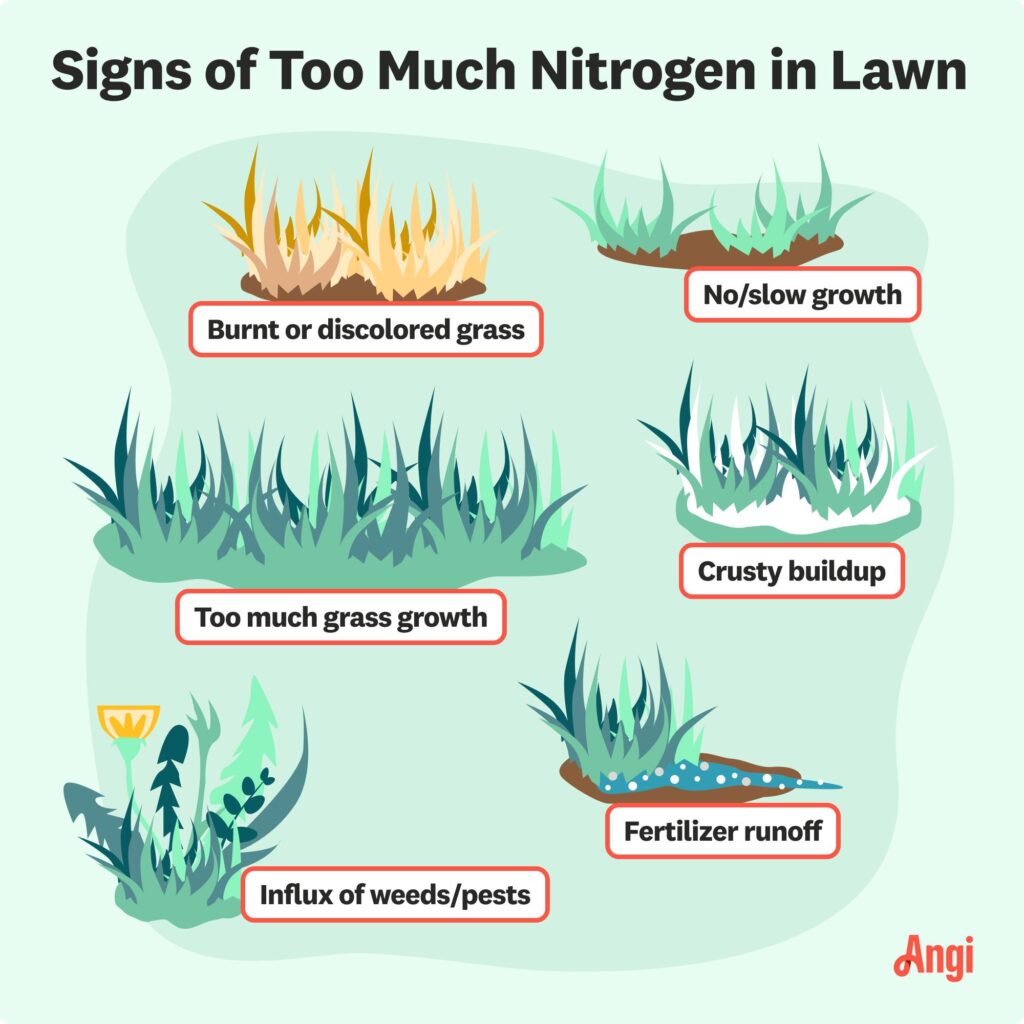
Nitrogen excess symptoms:
- Rapid, excessive growth requiring frequent mowing
- Dark, almost bluish-green color
- Soft, lush growth that’s more susceptible to disease
- Increased lawn disease pressure (brown patch, dollar spot)
- Fertilizer burn — brown, scorched patches following the spreader pattern
- Elevated thatch accumulation as grass grows faster than organic matter can decompose
The target is a lawn that’s healthy and deep green without being excessively lush. If you’re mowing more than once a week and the clippings are heavy and wet, you’ve likely crossed into excess nitrogen territory.
Soil Testing: The Smartest First Step
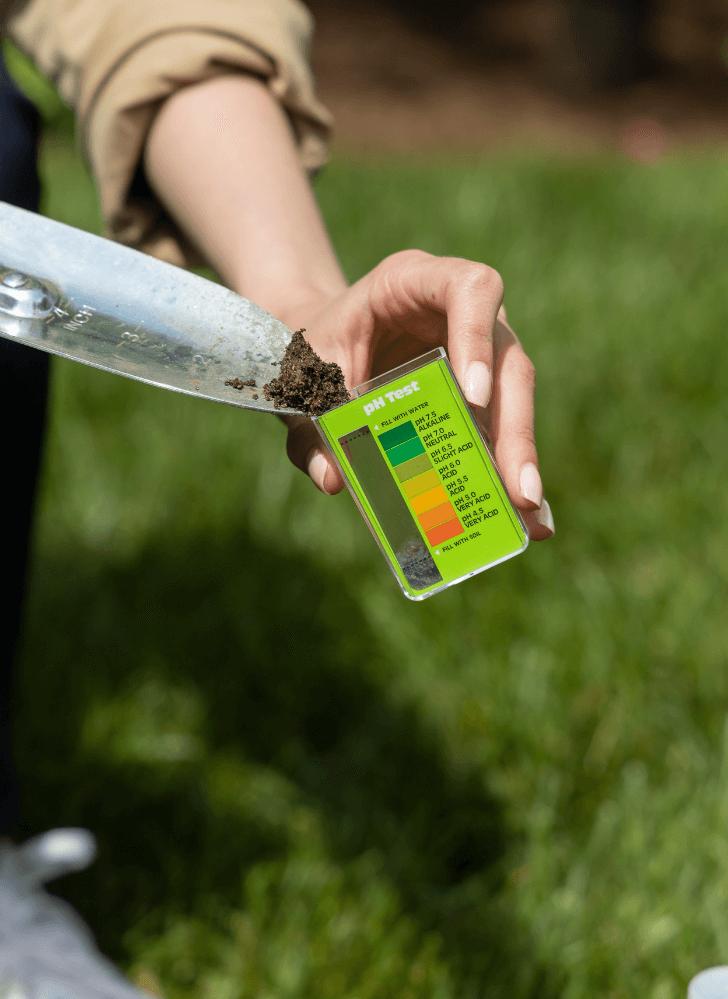
Before applying any nitrogen fertiliser, a soil test tells you what you’re actually working with. It costs a few dollars through your local cooperative extension service and provides a full nutrient profile, pH reading, and specific fertiliser recommendations for your lawn.
Soil pH directly affects nitrogen availability. At pH below 6.0 or above 7.5, even correctly applied nitrogen may not be accessible to grass roots. Most cool-season grasses prefer a pH of 6.0–7.0; warm-season grasses generally do well between 5.5 and 7.0.
If your soil pH is off, no amount of nitrogen fertiliser fully compensates. Lime applications correct acidic soil; sulphur treatments lower pH in alkaline conditions. Getting pH right first means every dollar spent on fertiliser works harder.
Environmental Responsibility: Preventing Nitrogen Runoff
Nitrogen runoff is a real environmental issue. Excess nitrogen from residential lawns contributes to eutrophication — algae blooms in lakes, streams, and coastal waters that deplete oxygen and kill aquatic life. Many municipalities now restrict fertiliser use near waterways, and some states have enacted “fertiliser blackout” periods during wet seasons.
Practical steps to minimise runoff:
- Maintain a 10-foot buffer from any stream, pond, or drainage ditch — apply no fertilizer in this zone
- Don’t fertilize before heavy rain — check the forecast before every application
- Sweep fertilizer granules off sidewalks, driveways, and streets immediately after application — granules on hard surfaces wash directly into storm drains
- Calibrate your spreader accurately — over-application is the primary driver of excess nitrogen leaching
- Use slow-release nitrogen when possible — it dramatically reduces the amount of soluble nitrogen available for leaching at any one time
Responsible nitrogen management isn’t just good for waterways — it’s better for your lawn too. Steady, controlled nitrogen release produces more consistent results than boom-bust feeding cycles.
Common Nitrogen Fertilizer Mistakes (And How to Fix Them)
Mistake 1: Applying too much too fast. Even experienced homeowners misjudge spreader settings and dump too much product in one pass. If you suspect over-application, water heavily for several days to dilute nitrogen concentration in the soil and reduce burn risk.
Mistake 2: Fertilising in summer heat without a slow-release product. Fast-release nitrogen on hot, dry turf is a reliable way to burn the lawn. Postpone summer feeding until temperatures moderate, or switch to a predominantly slow-release product.
Mistake 3: Skipping the fall application. For cool-season grass owners, fall is actually more important than spring. The fall nitrogen application is what drives root development, helps the lawn store carbohydrate reserves for winter, and sets up spring green-up. Missing it is the single biggest mistake cool-season lawn owners make.
Mistake 4: Fertilising dormant warm-season grass. Applying nitrogen to dormant bermudagrass or zoysiagrass in winter does nothing productive — the grass can’t use it. It sits in soil, leaches, or feeds weeds instead.
Mistake 5: Ignoring the soil. Nitrogen applied to heavily compacted soil, or soil with very low organic matter, doesn’t behave the same way it does in healthy soil. Aeration and organic matter improvement (compost topdressing) create conditions where nitrogen is used efficiently rather than leaching or volatilising.
Frequently Asked Questions
How often should I apply nitrogen fertiliser to my lawn?
For cool-season grasses, 3–4 applications per year is typical — primarily in fall, with a spring and optional late-spring application. Warm-season grasses can handle monthly feeding during active summer growth, typically 4–6 applications between May and September.
Can I apply nitrogen fertiliser and weed killer at the same time?
Many combination products (“weed and feed”) contain both, but timing a weed control application to your fertiliser schedule isn’t always ideal. Pre-emergent herbicides are most effective at specific soil temperatures that may or may not align with your best nitrogen application timing. Using them separately gives you more control over both.
What is the best nitrogen fertiliser for new grass seed?
New seedlings need phosphorus for root development more than nitrogen. A starter fertiliser with an NPK like 10-18-10 or 12-24-12 is better suited to seeding. Once grass is established and has been mowed 2–3 times, a regular nitrogen programme can begin.
Is it better to use organic or synthetic nitrogen?
Both produce good results when used correctly. Organic nitrogen builds long-term soil health but acts slowly. Synthetic nitrogen produces faster visible results but requires more precision. Many experienced turf managers use a blend of both for best performance.
What happens if I apply nitrogen to a wet lawn?
Applying granular nitrogen to wet grass isn’t ideal — granules can stick to blades rather than falling through to the soil, increasing the risk of foliar burn when the sun comes out. Apply to dry grass, then water it in afterward.
How do I know if my lawn has enough nitrogen without a soil test?
Colour is the most reliable visual indicator. A lawn with adequate nitrogen is a deep, saturated green and grows at a steady, moderate pace. Pale green, yellow-green, or slow-growing turf across the whole lawn usually points to nitrogen deficiency.
Can I use nitrogen fertiliser on a newly laid sod lawn?
Wait 4–6 weeks before applying standard nitrogen fertiliser to new sod. The roots need time to establish themselves in the soil. Some professionals apply a light starter fertiliser at installation, but full nitrogen programmes should wait until the sod is rooted and has been mowed at least once.