
Gardening & Plant Nutrition · 10 min read
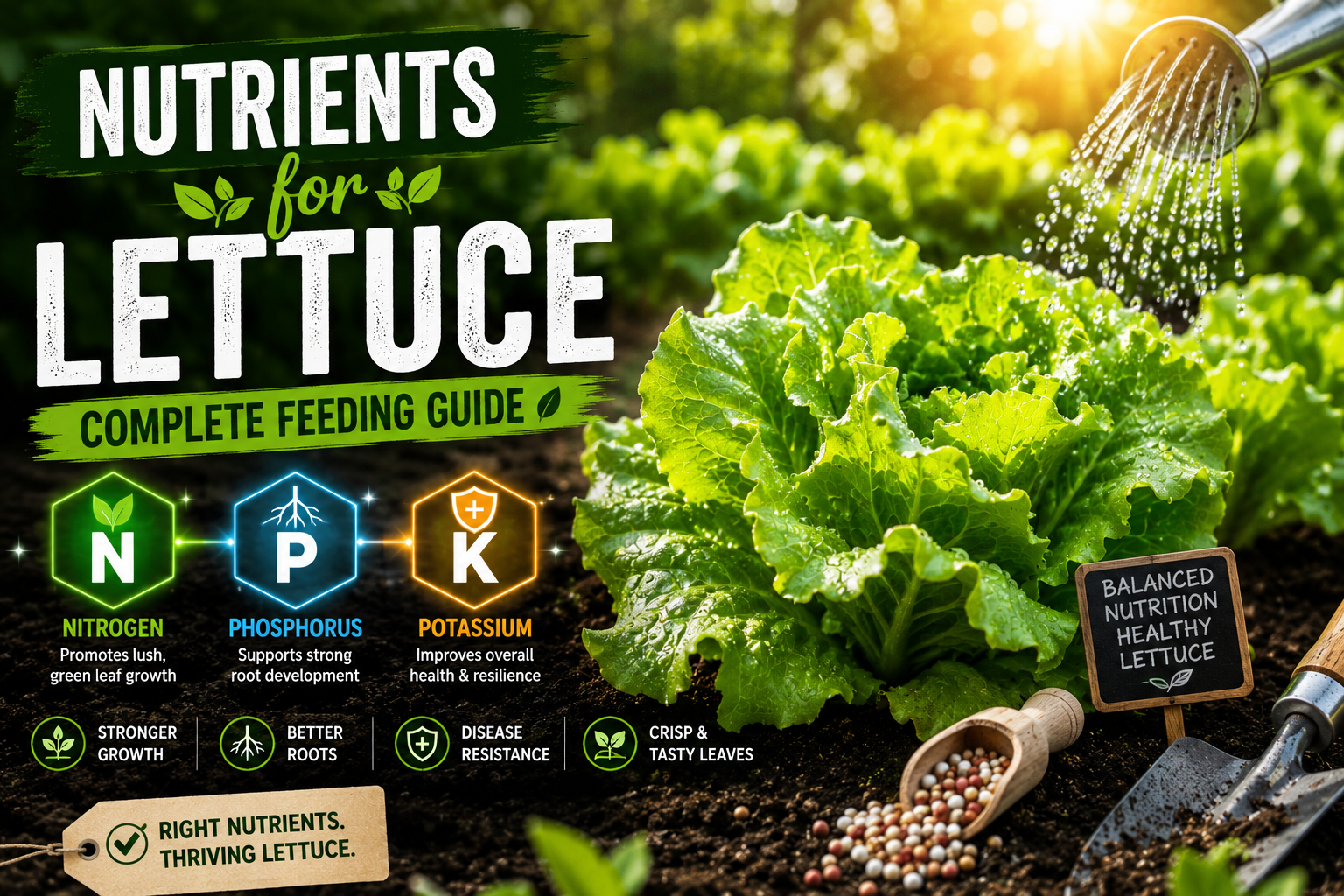 Healthy lettuce starts with the right balance of nutrients.
  Discover the essential nutrients for lettuce growth, including nitrogen, phosphorus, potassium, calcium, and magnesium for greener leaves, faster growth, and higher yields.
 #NutrientsForLettuce #LettuceGrowing #Hydroponics #GardeningTips #Healthy
Nutrients for Lettuce: The Complete Guide to Feeding Healthy Greens
Getting the nutrition right is the single biggest difference between lettuce that’s pale, bitter, and bolts early and lettuce that grows thick, crisp, and sweet. Most gardeners are either overfeeding or missing a key element entirely.
Lettuce (Lactuca sativa) is deceptively simple to grow, but its nutritional requirements are more nuanced than most people realise. Because it grows so fast, most varieties are ready in 45 to 75 days; it needs a steady supply of the right nutrients at the right times. Too much nitrogen late in the season and you get soft, bitter leaves. Too little calcium and you get tip burn that ruins the inner head before you even see it. Understanding what lettuce actually needs, and when, changes everything about how your crop turns out.
This guide covers every major nutrient lettuce requires, what happens when something’s off, how to feed it in both soil and hydroponic systems, and a practical schedule you can follow from transplant to harvest. No guesswork, no generic advice—just the specifics that matter for this crop.
The Three Primary Nutrients Lettuce Depends On:
All plants need 17 essential elements to complete their life cycle. For lettuce, three of those—nitrogen, phosphorus, and potassium—form the backbone of any effective fertilisation programme. They’re referred to as macronutrients or NPK, after their chemical symbols. Understanding what each one actually does helps you make smarter feeding decisions rather than just following a label.
N
Nitrogen
Leaf growth, green color, cell division
P
Phosphorus
Root development, energy transfer, maturity
K
Potassium
Water regulation, leaf firmness, disease resistance
Nitrogen: The Leaf-Building Engine
Nitrogen is the most critical nutrient for lettuce, and it’s not even close. Since lettuce is grown entirely for its leaves, nitrogen directly controls how big, green, and productive the plant becomes. It drives chlorophyll production, amino acid synthesis, and the rapid cell division that gives you full, dense heads.
When nitrogen is adequate, lettuce grows quickly with a deep green colour and broad, well-formed leaves. When it’s deficient, the oldest leaves turn pale yellow first—a process called chlorosis—and the plant stalls. Growth slows visibly within a week or two of nitrogen deprivation. In contrast, excess nitrogen causes rapid, overly lush growth that’s soft, watery, and more susceptible to disease. It can also make leaves taste bitter and cause the plant to bolt (go to seed) prematurely.
For most soil-based lettuce, a nitrogen level of around 80–120 parts per million (ppm) in available form is considered ideal during active growth. In hydroponic systems, the target is typically 150–200 ppm of nitrogen in the reservoir solution.
Phosphorus: The Root and Energy Nutrient
Phosphorus tends to get overapplied in vegetable gardens because gardeners associate it with “strong plants”, but lettuce doesn’t need nearly as much as crops like tomatoes or squash. Its role in lettuce is primarily supporting root development in the early stages, transferring energy within the plant (as ATP—adenosine triphosphate), and facilitating the maturity process that leads to proper head formation.
Phosphorus deficiency shows up as stunted growth, poor root systems, and a reddish-purple discolouration on the undersides of lower leaves. This discolouration comes from anthocyanin accumulation when phosphorus is unavailable to support normal cell metabolism. Fortunately, most garden soils contain adequate phosphorus, and lettuce rarely shows deficiency symptoms in well-maintained beds. In hydroponic systems, the recommended range is 50–80 ppm of phosphorus.
Potassium: The Regulator
Potassium doesn’t build plant tissue the way nitrogen does, but it governs virtually every physiological process that keeps lettuce performing well. It regulates the opening and closing of stomata (the pores through which plants breathe and lose water), which affects how efficiently the plant uses water and handles heat stress. It also activates enzymes, supports sugar transport, and directly impacts the crispness and texture of leaves, which is exactly what makes lettuce worth eating.
Lettuce with sufficient potassium is firmer, better tasting, more resistant to fungal pathogens, and holds up longer after harvest. A potassium deficiency typically shows as scorched, brown leaf margins—starting with the older leaves and moving inward. In hydroponic nutrient solutions, potassium levels are kept higher than nitrogen’s and phosphorus’s, typically at 200–250 ppm, reflecting how much of it lettuce actually uses.
Recommended NPK Ratio for Lettuce
Most agronomists and commercial growers recommend an NPK ratio in the range of 8-15-36 for water-soluble lettuce fertilisers or a moderate-nitrogen balanced formula like 5-10-15 for hydroponic solutions. The emphasis on potassium over nitrogen reflects lettuce’s need for firm, flavourful leaves rather than simply bulk growth.
Secondary Macronutrients: Calcium, Magnesium, and Sulfur
Below NPK sits a second tier of macronutrients that plants need in meaningful quantities: calcium (Ca), magnesium (Mg), and sulphur (S). These three are often overlooked in basic fertilisation programmes, yet deficiencies in any of them cause specific, recognisable problems in lettuce—some of which can destroy a crop’s market value.
Calcium: Critical for Tip Burn Prevention
Calcium is structurally essential for lettuce. It reinforces cell walls, promotes healthy new growth, and is the primary factor behind one of the most common lettuce problems: tipburn. Tip burn is the browning and death of inner leaf margins, caused not by low calcium in the soil but by poor calcium transport within the plant under high-transpiration conditions. Hot, humid weather, poor air circulation, or too-rapid growth can all trigger it even when soil calcium is adequate.
In hydroponic lettuce, calcium is typically maintained at 100–150 ppm and is often supplied through calcium nitrate, which also contributes nitrogen. Without enough calcium, new growth becomes dark and wavy, and young leaves develop brownish-grey spots. In soil, incorporating gypsum, crushed eggshells, or limestone before planting helps maintain good calcium availability. The target soil pH for calcium availability is 6.0–7.0—outside that range, calcium can be present but chemically locked out.
Magnesium: The Chlorophyll Central Atom
Every molecule of chlorophyll contains a magnesium atom at its centre. That’s not a minor role—it means magnesium is directly tied to a plant’s ability to photosynthesise and produce energy. In lettuce, magnesium deficiency produces a distinctive interveinal chlorosis on older leaves: the leaf veins remain green while the tissue between them turns yellow. As the deficiency worsens, entire leaves curl downward and develop necrotic spots.
Magnesium can become unavailable even when present in soil, particularly when potassium levels are very high (the two ions compete for uptake sites on roots) or when soil pH drops below 5.5. Epsom salt (magnesium sulphate) dissolved in water is one of the fastest ways to correct a deficiency as a foliar spray—20 g per litre, applied in the early morning or evening to avoid leaf scorch. In hydroponic systems, Epsom salt is a standard component of complete nutrient formulas.
Sulfur: Often Overlooked, Always Needed
Sulphur plays a supporting role in protein synthesis and enzyme function. Because it’s needed in smaller quantities than calcium or magnesium, deficiency is less common—but it does occur, especially in sandy soils with low organic matter. Sulphur deficiency produces an all-over yellowing that affects veins and tissue equally, which distinguishes it from nitrogen deficiency (which affects older leaves first) and magnesium deficiency (which spares the veins). Most complete fertilisers and compost provide adequate sulphur.
Micronutrients Lettuce Needs (And What Happens Without Them)
Micronutrients are needed in trace amounts—parts per million rather than percentage points—but their absence causes specific, often severe problems. For lettuce grown in healthy, well-amended garden soil, micronutrient deficiencies are relatively rare. For lettuce in containers, raised beds with limited soil volume, or hydroponic systems, it requires active management.
| Micronutrient | Primary Role in Lettuce | Deficiency Sign | Fix |
|---|---|---|---|
| Iron (Fe) | Chlorophyll synthesis, enzyme activation | Interveinal chlorosis on young leaves | Chelated iron: lower pH if above 7 |
| Manganese (Mn) | Photosynthesis support, nitrogen metabolism | Interveinal chlorosis on newer leaves | Manganese sulfate; pH adjustment |
| Boron (B) | Cell wall development, calcium uptake | Swollen, distorted growing tips; hollow hearts | Borax at very low dose; avoid overdose |
| Zinc (Zn) | Enzyme production, growth hormone regulation | Stunted new growth, small leaves | Zinc sulfate or chelated zinc |
| Copper (Cu) | Enzyme function, lignin formation | Whitish-gray lesions on mature leaves; crinkled leaves | Copper sulfate; use sparingly |
| Molybdenum (Mo) | Nitrogen processing in leaves | Cupped, pale leaves; marginal scorch | Sodium molybdate: pH above 6.5 usually resolves it |
Important: pH Controls Micronutrient Availability
Most micronutrient deficiencies in lettuce aren’t caused by the nutrients being absent from the soil; they’re caused by the soil pH being too high or too low. Iron, manganese, zinc, copper, and boron all become chemically unavailable above pH 7.5. Molybdenum, on the other hand, becomes unavailable below pH 6. The sweet spot for lettuce is a soil pH of 6.0–7.0, which keeps all essential micronutrients available simultaneously.
Organic Nutrient Sources That Work Well for Lettuce
Organic fertilisers work differently from synthetic ones. Rather than delivering nutrients in immediately available ionic form, they rely on soil microbial activity to break down organic matter and release nutrients gradually. This slower release matches lettuce’s steady (rather than heavy) feeding pattern well, and it also improves soil structure over time, which benefits water retention and root access in shallow-rooted crops like lettuce.
Compost and Well-Rotted Manure
A 2–4 inch layer of finished compost worked into the top 6 inches of soil before planting is one of the most reliable ways to establish a nutrient base for lettuce. Well-rotted compost typically provides a balanced low-level NPK (around 1-1-1 or similar) along with a broad spectrum of micronutrients, beneficial organisms, and humic acids that improve nutrient uptake. Chicken manure is higher in nitrogen than most composts, making it particularly useful in nitrogen-depleted soils—but it must be fully composted to avoid burning roots and introducing pathogens.
Fish Emulsion
Fish emulsion is a fast-acting liquid fertiliser typically ranging from 2-4-1 to 5-2-2 NPK. It’s one of the better organic options for in-season nitrogen feeding because it becomes available within a few days of application. Many experienced lettuce growers apply a half-strength fish emulsion solution every two weeks during active growth to maintain steady nitrogen levels without risking excess. The smell is strong, but it dissipates quickly outdoors.
Seaweed and Kelp Extracts
Kelp meal and liquid seaweed extracts are low in primary macronutrients but rich in trace minerals, plant hormones (particularly cytokinins), and compounds that stimulate root growth and stress tolerance. They’re best used as supplements to a broader nutrition programme rather than primary fertilisers. Foliar applications of diluted seaweed extract during periods of heat stress or transplant shock can noticeably improve lettuce recovery and resilience.
Blood Meal and Feather Meal
Blood meal (approximately 12-0-0 NPK) is one of the highest-nitrogen organic amendments available. It releases relatively quickly compared to other organic materials and is useful for correcting severe nitrogen deficiency mid-season. Feather meal breaks down more slowly but provides a sustained nitrogen release over 3–4 months. Both should be used carefully—high doses of blood meal, in particular, can burn plants and acidify soil over time.
Nutrients for Hydroponic Lettuce: A Different Approach
Hydroponic lettuce is one of the most beginner-friendly crops for systems like NFT (Nutrient Film Technique), DWC (Deep Water Culture), Kratky, and ebb-and-flow setups. But because there’s no soil to buffer or supply nutrients, the grower has complete responsibility for delivering everything the plant needs in the right concentrations and the right balance.
The fundamental difference from soil growing is this: in soil, nutrients exist in various chemical forms and are released through microbial activity, weathering, and ion exchange. In hydroponics, the plant gets only what’s dissolved in the water—and it must be in the right ionic form, at the right pH, and at the right concentration to be absorbed through roots.
EC and pH: The Two Numbers That Run Everything
Electrical Conductivity (EC) measures the total dissolved mineral content of a nutrient solution. Higher EC means more nutrients (and salts) in solution. For lettuce specifically, the ideal EC range is relatively low—typically 0.8 to 1.6 mS/cm for young seedlings and 1.2 to 2.0 mS/cm for mature plants. Lettuce is sensitive to high-salt conditions and will show tip burn and edge browning when EC climbs too high.
pH governs which nutrients the roots can actually absorb. The optimal pH for hydroponic lettuce is 5.5 to 6.5. Below 5.5, calcium and magnesium become less available. Above 6.5, iron, manganese, and zinc start locking out. Monitor pH daily and adjust with pH-up (typically potassium hydroxide or potassium silicate) and pH-down (typically phosphoric acid) solutions as needed. Reservoir temperature also matters—water above 24°C (75°F) holds less dissolved oxygen and encourages root rot, which can mimic nutrient deficiency.
The MasterBlend Formula: A Widely Used Starting Point
Among home hydroponic growers, a three-part formula combining a base nutrient with calcium nitrate and Epsom salt has become popular for lettuce because it delivers a complete nutrient profile at a low cost. The typical mixing ratio (by weight) is 2.4 g base nutrient + 2.4 g calcium nitrate + 1.2 g Epsom salt per gallon of water. This produces a balanced solution with approximately 150–200 ppm nitrogen, adequate calcium and magnesium, and a full micronutrient complement when the base nutrient includes chelated trace elements. It’s used by both amateur growers and commercial operations.
| Nutrient | Target PPM (Hydroponic) | Role in Solution |
|---|---|---|
| Nitrogen (N) | 150–200 ppm | Leaf growth and color |
| Phosphorus (P) | 50–80 ppm | Root development, energy transfer |
| Potassium (K) | 200–250 ppm | Leaf texture, water regulation |
| Calcium (Ca) | 100–150 ppm | Cell wall strength, tip-burn prevention |
| Magnesium (Mg) | 30–50 ppm | Chlorophyll production |
| Iron (Fe) | 1–2 ppm | Chlorophyll synthesis (chelated form) |
Diagnosing Nutrient Deficiencies in Lettuce
One of the most useful skills a lettuce grower can develop is reading plant symptoms accurately. The same yellowing can mean half a dozen different things depending on which leaves are affected, whether the veins are involved, and what colour changes appear. Getting this wrong leads to adding the wrong correction, which can make problems worse.
The key diagnostic principle: nutrients that are mobile in the plant (nitrogen, phosphorus, potassium, and magnesium) show deficiency symptoms in older (lower) leaves first because the plant pulls them from older tissue to support new growth. Nutrients that are immobile (calcium, iron, boron, zinc, and copper) show symptoms in younger (upper) leaves first because they can’t be relocated once deposited.
| Symptom | Location | Likely Cause |
|---|---|---|
| Overall yellowing, slow growth | Older leaves first | Nitrogen deficiency |
| Purple/red undersides of leaves | Older leaves | Phosphorus deficiency |
| Brown, scorched leaf margins | Middle and older leaves | Potassium deficiency |
| Brown tips on inner leaves (tip burn) | New inner growth | Calcium deficiency / transport issue |
| Yellow between leaf veins, veins stay green | Older leaves | Magnesium deficiency |
| Yellow between leaf veins, veins stay green | Young, new leaves | Iron deficiency |
| Distorted, swollen growing tip | Growing tip | Boron deficiency |
| Crinkled leaves with whitish patches | Mature leaves | Copper deficiency |
A Practical Lettuce Fertilizer Schedule
Lettuce doesn’t need a complex feeding programme. What it needs is consistent, correctly timed application of appropriate nutrients. The schedule below works for soil-grown lettuce in garden beds or containers, starting from transplanting or direct seeding to harvest.
Before Planting (Soil Prep)
Work 2–4 inches of finished compost into the top 6 inches of soil. If a soil test shows phosphorus is low, add a slow-release phosphorus source at this stage. Test and adjust pH to 6.0–7.0 using lime (to raise) or sulphur (to lower). This base preparation reduces how much in-season feeding you’ll need.
At Transplanting (Week 0)
Water transplants with a diluted balanced liquid fertiliser (half strength) or a kelp/seaweed solution to reduce transplant shock and encourage rapid root establishment. Avoid heavy nitrogen at this stage—it can push leaf growth before roots are established, stressing the plant.
Active Growth Phase (Weeks 2–4)
Begin regular feeding every 10–14 days with a nitrogen-forward liquid fertiliser. Fish emulsion (5-1-1 or similar) at half strength works well organically. Synthetic growers can use a water-soluble balanced formula. This is the phase where nitrogen availability has the biggest impact on head size and leaf production.
Head Formation (Weeks 4–6)
Reduce nitrogen slightly and maintain or increase potassium. This improves leaf texture and firmness. Continue regular watering—consistent moisture is as important as feeding at this stage, since calcium uptake depends on steady water flow through the plant. Irregular watering causes tip burn even with adequate soil calcium.
Two Weeks Before Harvest
Stop nitrogen feeding entirely. This allows existing nitrogen to be used up and improves flavour. Some experienced growers withhold all fertiliser for the final 10–14 days, finding it produces tighter, better-flavoured heads with less bitterness. Continue watering normally.
Container Growing Note
Container-grown lettuce needs more frequent feeding than garden beds because nutrients leach out with every watering. Feed every 7–10 days at half strength rather than every 14 days at full strength. This maintains steady nutrient levels without salt buildup in the limited soil volume.
Over-Fertilization: A Bigger Problem Than Most Growers Expect
The instinct to feed more when lettuce looks healthy—or to compensate for past neglect—often creates bigger problems than the deficiency it was meant to fix. Lettuce is more sensitive to nutrient excess than many crops, partly because of its shallow root system and rapid growth rate.
Excess nitrogen is the most common form of over-fertilisation in home gardens. It causes plants to grow rapidly but produces soft, watery tissue that’s highly attractive to aphids and slugs. The leaves become large but pale (a counterintuitive effect of nitrogen excess at very high levels, as it disrupts chlorophyll formation). Worse, over-nitrogenised lettuce tastes bitter, bolts faster, and has significantly poorer post-harvest shelf life.
Fertiliser salt buildup in containers is another concern. When soluble fertilisers are applied repeatedly without leaching, dissolved salts accumulate in the soil and create osmotic stress—plants cannot absorb water effectively even when the soil is wet. Signs include wilting despite moist soil and brown leaf margins similar to potassium deficiency. The fix is to flush the container thoroughly with plain water to leach accumulated salts.
Do Different Lettuce Varieties Have Different Nutrient Needs?
The core nutrient requirements are consistent across lettuce types—all need nitrogen, phosphorus, potassium, calcium, and the full complement of micronutrients. But there are practical differences in how efficiently different types use nutrients, and some varieties are bred specifically to tolerate conditions where others struggle.
Butterhead types like Boston and Bibb lettuce tend to be more sensitive to tip burn than romaine or loose-leaf varieties, making calcium management more critical. Loose-leaf lettuce varieties—Red Sails, Oak Leaf, and Black Seeded Simpson—are the most forgiving under imperfect fertility conditions and grow faster than head-forming types, meaning they cycle through available nutrients more quickly. Romaine varieties have a longer growing period and benefit from a more sustained feeding programme.
Crisphead (iceberg) lettuce is the most demanding in terms of calcium and overall nutrient management. It’s also the most sensitive to tip burn and requires the most precise irrigation and nutrition timing to form proper heads. For home gardeners, it’s worth noting that romaine and loose-leaf types not only produce well with less precise management—they’re also more nutritionally dense in the final product.
Frequently Asked Questions
What is the best NPK fertiliser ratio for lettuce?
How often should I fertilise lettuce?
Why are the tips of my lettuce leaves turning brown?
Can I use coffee grounds as fertiliser for lettuce?
What pH should the soil be for growing lettuce?
Does lettuce need fertiliser if I grow it in compost-rich soil?
What nutrients does hydroponic lettuce need that soil-grown lettuce doesn’t?